
Every business has at least one process that everybody quietly dislikes. It might be the quotation that requires someone to open five different systems before it can be sent. It might be the spreadsheet that has to be updated manually every morning, or the approval that sits inside WhatsApp until someone remembers to respond. It could also be a customer request that moves from email to Excel to ERP to another employee before anything meaningful actually happens.
These processes are rarely dramatic enough to trigger a major technology project. Most companies simply learn to live with them. Someone figures out the workaround, another employee learns how to follow it, and eventually the workaround becomes the normal way of doing business. What started as a temporary process slowly becomes permanent.
At JH Systems, we believe this is one of the best places to begin with automation. Rather than starting with a large digital transformation project, a long product list, or a vague promise about artificial intelligence, we prefer to begin with one real workflow. We look for the process that wastes time, creates delays, depends too heavily on one employee, or forces people to manually move information between systems, and then we examine how that process can be improved.
One Workflow Is Enough to Prove the Value
Businesses often delay automation because the subject feels too large. Words such as ERP transformation, AI agents, integration architecture and process automation can make the project sound expensive, complicated and disruptive before anyone has even identified the actual problem.
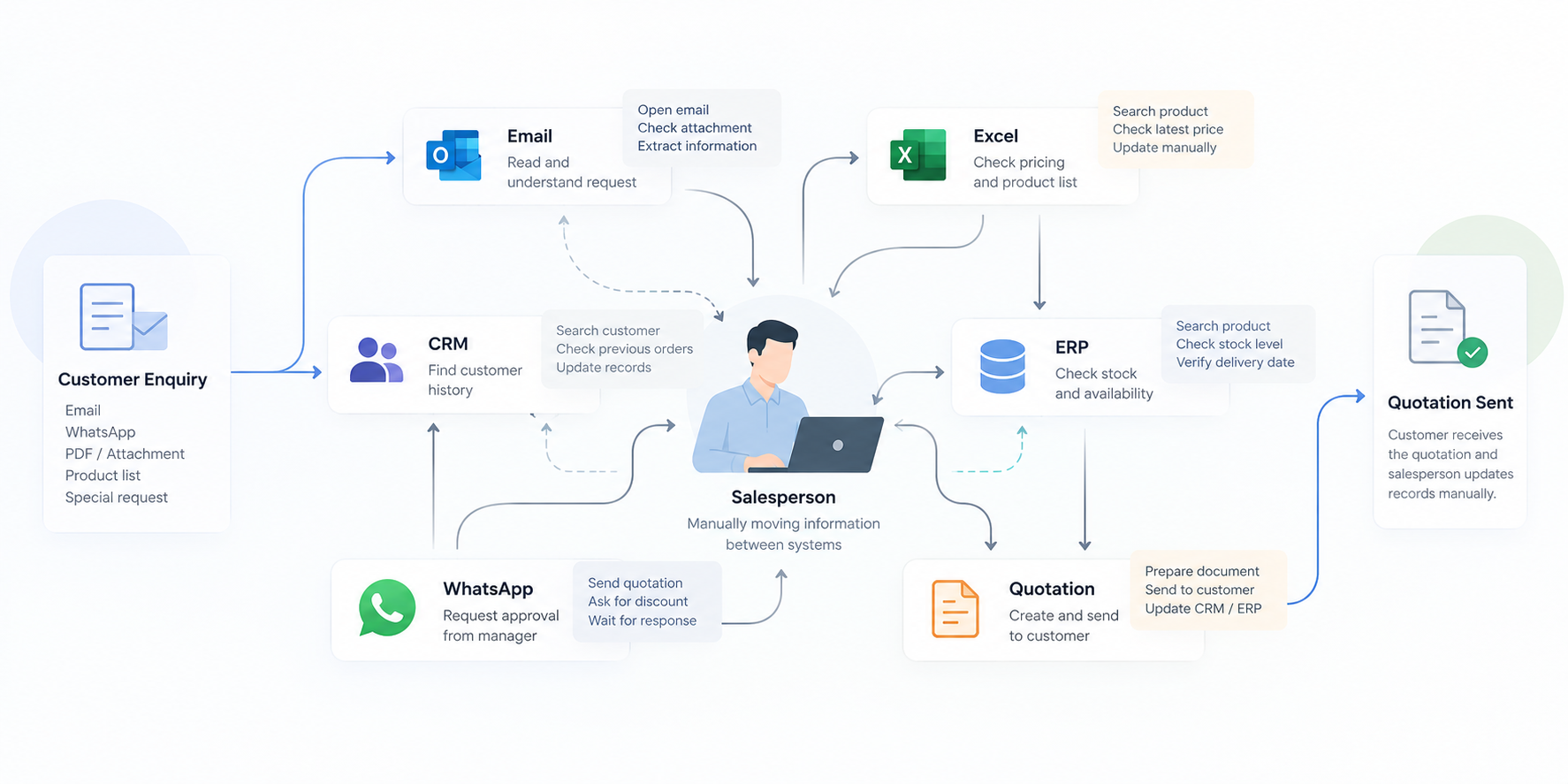
A more practical approach is to choose one process and study it properly. For example, imagine a trading company that receives quotation requests through email. A salesperson reads the message, opens an attached purchase request, searches the CRM for the customer, checks stock in the ERP, looks at a spreadsheet for pricing, calculates the quotation, asks a manager for approval on WhatsApp, prepares the final document, sends it to the customer and then updates the CRM again.
The process works, and the customer eventually receives the quotation. The more important question is how much unnecessary human effort was required before the quotation could be sent. That is where the automation conversation becomes useful.
First, We Watch What Actually Happens
Before automating anything, we need to understand the real workflow. That does not mean relying only on a management presentation or a written procedure. It means observing how the employees actually do the work every day.
We look at what happens when the enquiry arrives, which application is opened first, where information is searched, what gets copied and pasted, who needs to be contacted, where the process waits, and what happens when something does not go according to plan.
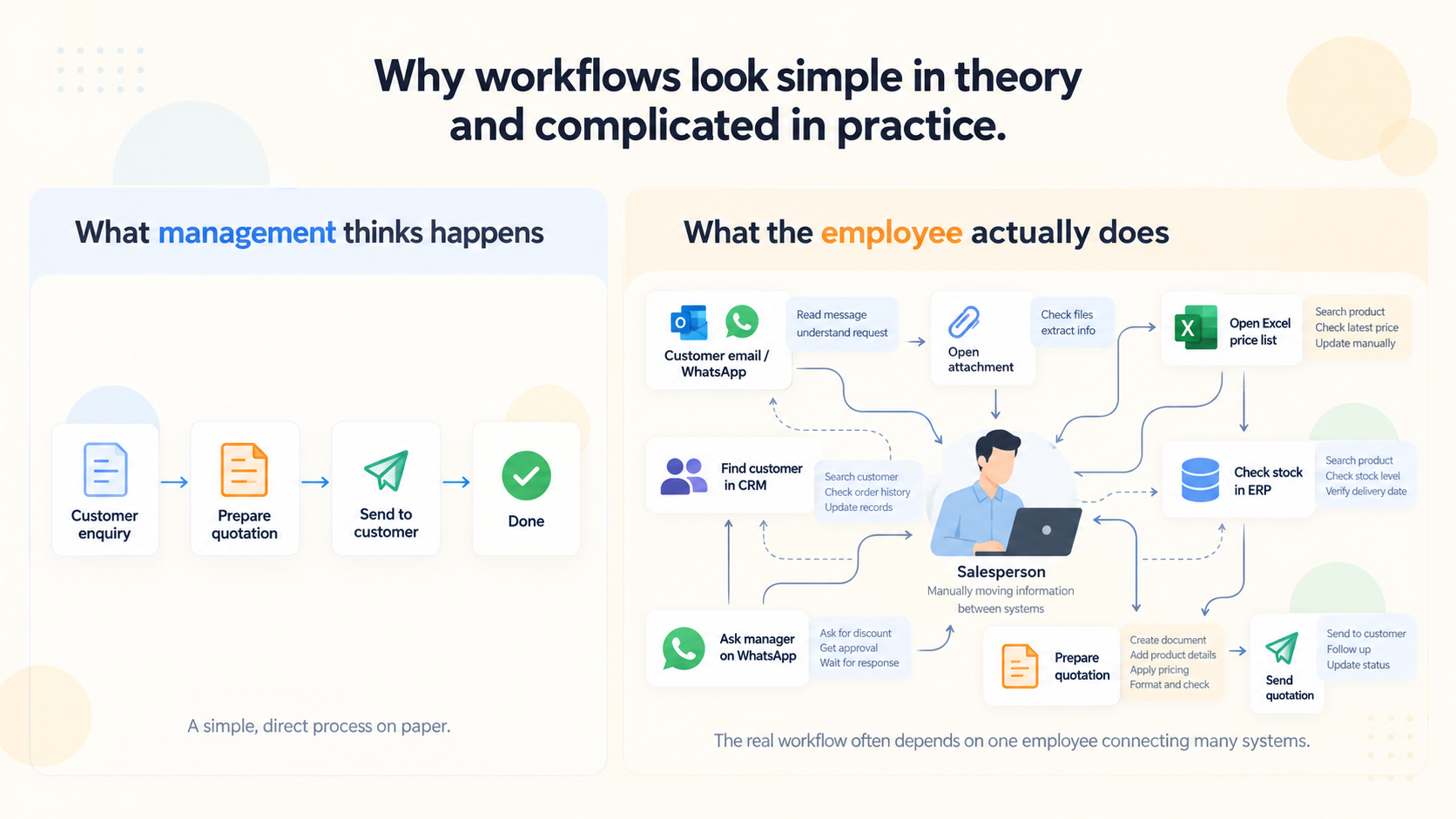
This matters because the official process and the real process are often very different. The company may believe that pricing comes from the ERP, while the sales team may actually rely on a spreadsheet because the ERP pricing structure was never configured properly. Management may assume that approvals are recorded, while in practice the approval is simply a message saying “approved” inside a WhatsApp chat.
The business may also believe that customer information is centrally managed, while the most accurate information is actually sitting in one salesperson’s phone. Those gaps are usually where the real automation opportunities are found.
Then We Make the Process Visible
Once the workflow is understood, the next step is to map it. A process that feels normal to employees can look surprisingly inefficient when everything is placed on one page.
A simple quotation process may turn into a chain involving the customer email, document review, CRM lookup, ERP stock check, pricing spreadsheet, manager approval, quotation creation, customer response, CRM update and follow-up.
The company may already own software capable of handling nearly every part of that process. The problem is that a person is responsible for carrying the workflow between those systems.
That employee becomes the integration layer. They move the data, remember what happens next, know where information is stored, understand which exception requires approval and know which person needs to be contacted when something goes wrong.
This approach may work while the business is small, but it becomes increasingly fragile as the company grows. More customers mean more transactions, more employees and more opportunities for delays or mistakes. At that point, the workflow begins to depend too heavily on individual knowledge.
Measuring the Work Nobody Usually Measures
One of the biggest problems with discussions about automation is that companies often talk about efficiency without measuring the current process.
If the existing workflow is not measured, it becomes difficult to know whether the new one is actually better.
Suppose a salesperson spends around eighteen minutes on repetitive administrative work for each quotation. Those eighteen minutes might be spent searching for customer information, checking multiple systems, copying data, requesting approval and updating records.
If the company prepares thirty quotations in a day, that becomes roughly nine hours of administrative effort across the team. Over twenty-two working days, the business could be spending close to two hundred hours every month on one process.
Those hours do not usually appear in one report. They are scattered across several employees, hundreds of small actions and countless moments throughout the working day. That is why the process can feel acceptable even while it consumes a significant amount of time.
A useful workflow assessment should make these costs visible. We can examine the average handling time, number of manual steps, number of systems involved, waiting time, repeated data entry, approval delays and the portion of the process that could realistically be automated.
Once those numbers are visible, automation becomes easier to evaluate as a business decision rather than as a technology trend.
The Goal Is Not to Remove People
Automation does not mean every human step should disappear. A salesperson may still need to review an important quotation. A manager may still need to approve a large discount. A technician may still need to decide how a repair should be handled. Finance may still need to review an unusual transaction.
The objective is not to remove those decisions. The objective is to remove the unnecessary administrative work surrounding them.
If software can collect the information, check the systems, prepare the relevant record and present the decision clearly, the employee can focus on the part where their judgement actually matters.
That is a better use of human time and a much more practical way to think about automation.
What the Improved Quotation Workflow Could Look Like
Now imagine the same trading company after the workflow has been redesigned.
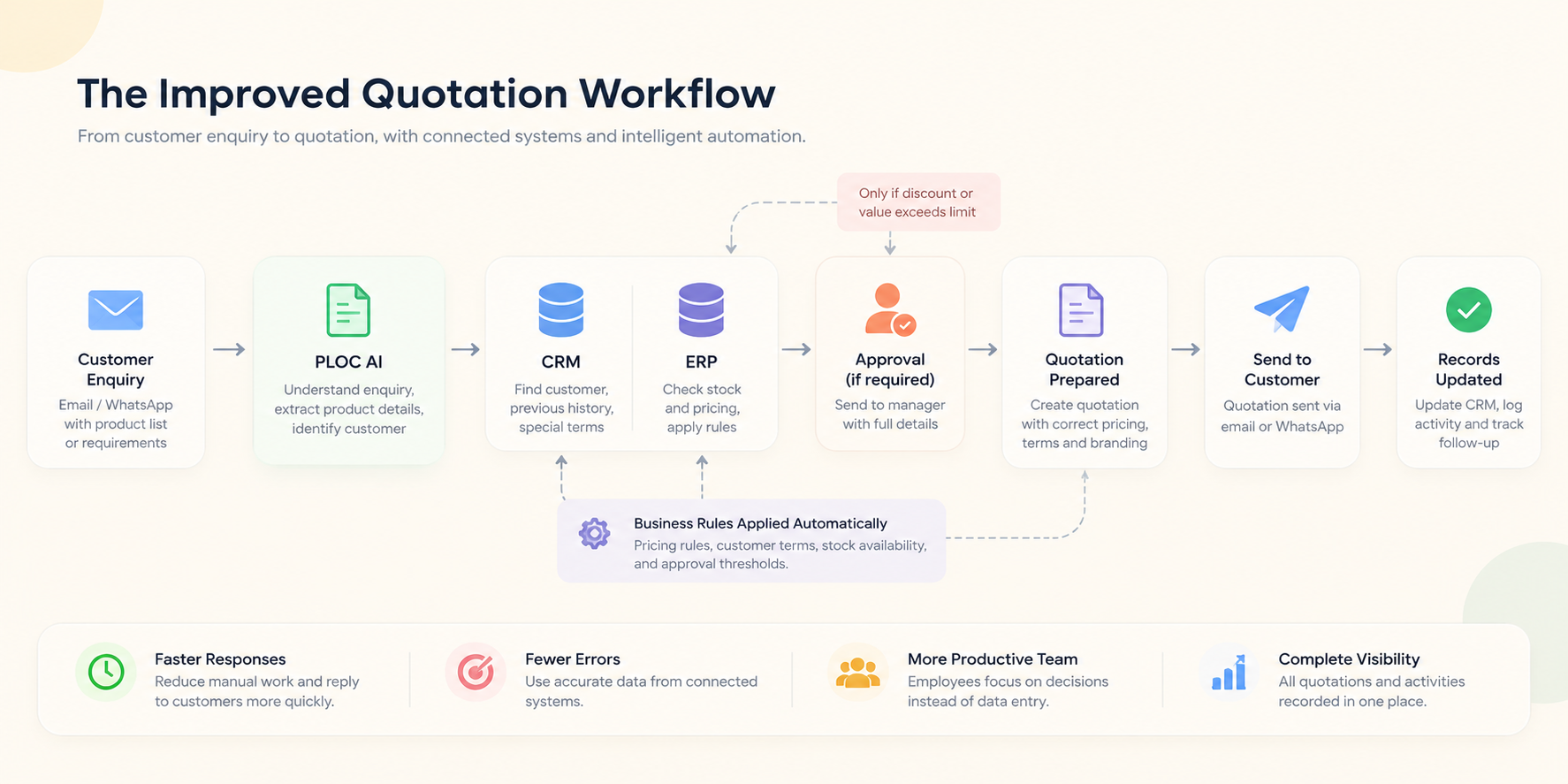
The customer sends an email, and PLOC AI recognises that the message is a quotation request. It can extract the customer information, product requirements, quantities, delivery details and relevant information from any attached document.
The workflow can then identify the customer inside the CRM, check product and stock information from the ERP, and retrieve pricing from the correct source.
If the quotation falls within normal rules, the process can continue automatically. If the discount or total value exceeds a defined threshold, the relevant manager can receive a structured approval request with all the required information already prepared.
After approval, the quotation can move to the next stage, the customer record can be updated and the appropriate follow-up can be created without the salesperson having to enter the same information again.
The employee remains involved, but their role changes. Instead of manually assembling the process, they supervise it, make the necessary commercial decisions and focus on the customer.
Fixing the Workflow Is More Important Than Automating a Single Step
There is an important difference between adding one automation and improving an entire workflow.
A company might automate the creation of a CRM lead every time an email arrives. That saves one step, but if the salesperson still needs to read the email, check inventory, search pricing, ask for approval, prepare the quotation and update the CRM afterward, the overall process has not changed very much.
This is why we prefer to look at the full sequence of work. The biggest opportunity often exists between the systems rather than inside any one of them.
The ERP may already be doing its job. The CRM may already be doing its job. Email may already be doing its job. The real inefficiency may be the manual effort required to connect all three.
Integration, custom workflows and PLOC AI can often create more value by fixing those gaps than by adding another isolated feature.
A Service Company Can Have the Same Problem in a Different Form
The same principle applies to service businesses.
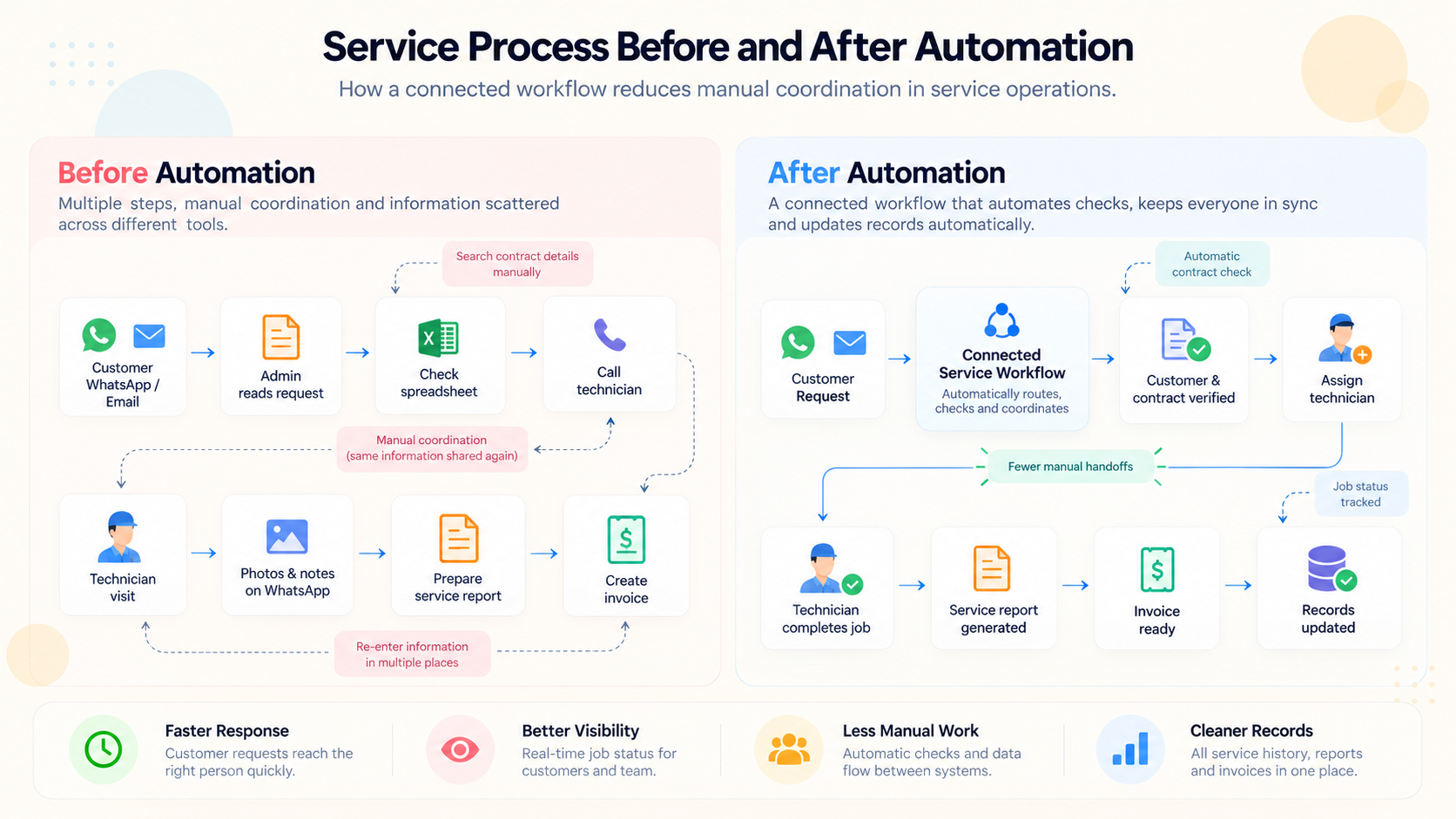
Imagine a maintenance company that receives service requests through WhatsApp and email. A customer reports that a machine has stopped working. An employee reads the message, asks for the customer location, searches a spreadsheet to see whether the machine is under contract, calls a technician, waits for the site visit, receives photos and notes through WhatsApp, prepares the service report and then passes the information to accounts for invoicing.
The process may work every day, but it depends on a large amount of manual coordination.
A better workflow could create a structured service request as soon as the customer message is received. The customer and contract information could be checked automatically, the job could be assigned based on location or technician availability, and the technician could receive the relevant history before attending the site.
Once the work is completed, the service report could move directly into the next stage, and if the job is billable, the information could continue toward invoicing without someone manually rebuilding the process from WhatsApp messages.
The technician, dispatcher and service manager still remain important. What changes is the amount of repetitive coordination they have to perform around the actual service work.
Sometimes the Right Answer Is ERP, and Sometimes It Is Not
One of the principles we follow at JH Systems is that the technology should be chosen after the process is understood.
Sometimes the correct solution is simply better ERP configuration. The company already owns the system it needs, but the workflow was never set up properly.
Sometimes a CRM process is the missing piece. In other cases, two systems need to communicate through an integration. A restaurant or hospitality business may be better served by a specialised system such as Clyro, while another company may genuinely require a custom module or application.
PLOC AI becomes especially useful where the workflow contains unstructured information such as emails, documents, customer messages or requests that require interpretation.
The technology can change from one business to another, but the principle stays the same. We start with the work rather than the product.
Starting Small Makes the Results Easier to See
Large technology projects can be valuable, but they also carry more risk. A company may spend months discussing requirements before employees see any real improvement.
Starting with one workflow makes the scope easier to understand. The current process can be measured, the employees involved can explain the problems clearly, and a working proof can be created much faster.
Most importantly, management can compare the before and after.
If a quotation process that once required twenty minutes of repetitive administration now requires only five minutes of review and decision-making, the value becomes clear.
Once the company sees that improvement, it can decide whether the same approach should be applied elsewhere.
The next workflow might be purchasing, customer service, invoice processing or management reporting. Automation can then grow gradually around real operational needs instead of becoming one large project based mostly on assumptions.
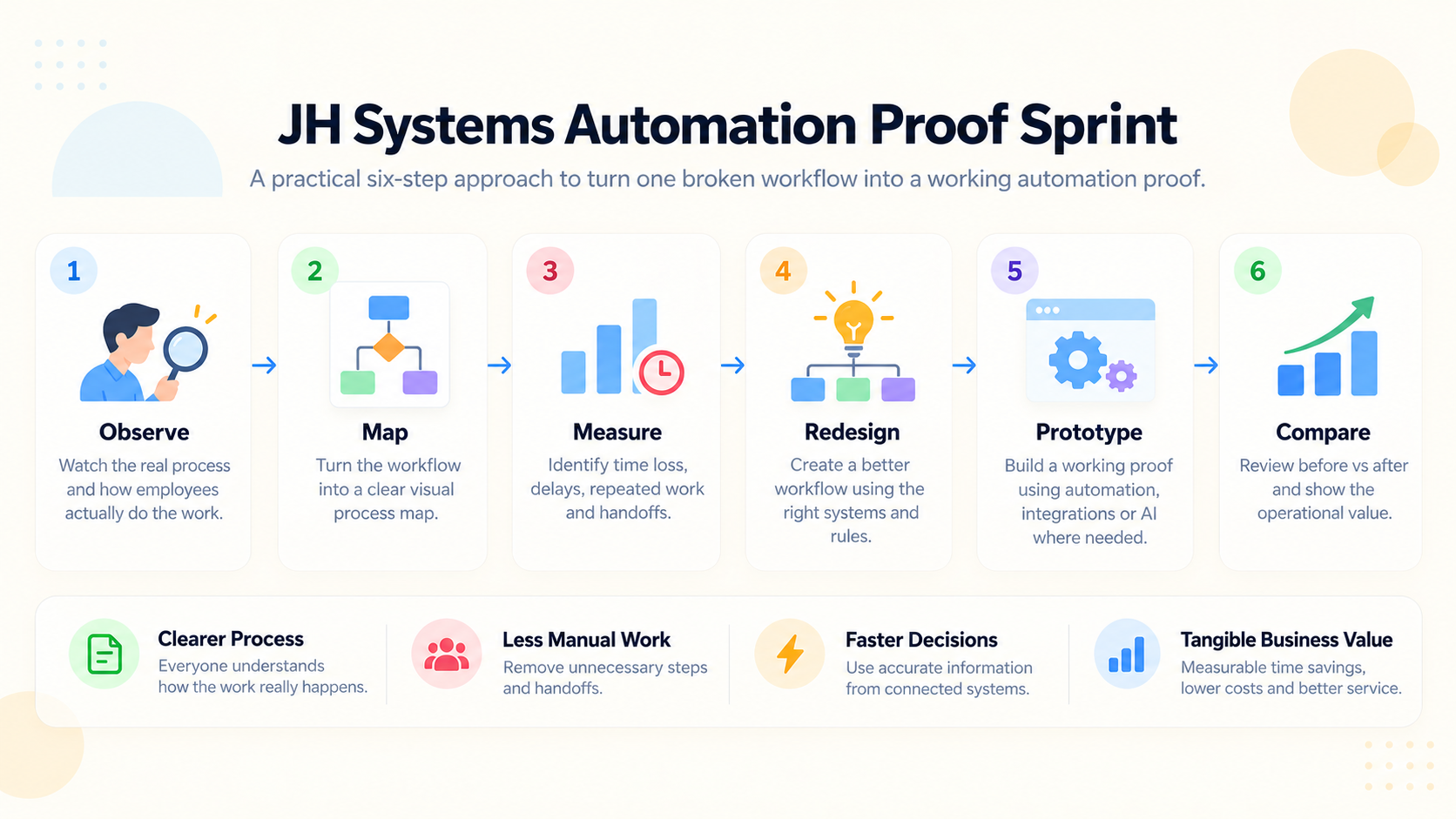
The JH Systems Automation Proof Sprint
This is the idea behind what we call an Automation Proof Sprint.
A business brings us one process that is slow, repetitive or frustrating. We study the real workflow, identify where time is being lost, map the process, measure the unnecessary work and determine what can realistically be improved.
From there, we design a better version of the process. Where practical, we can build a working proof using the company's existing systems, integrations, ERP or CRM workflows, custom development, Clyro, PLOC AI or a combination of these technologies.
The goal is not to finish with a document that simply says automation is possible. The business should be able to see how the process works today, how the improved workflow would operate and where the measurable benefit comes from.
The Starting Point Does Not Need to Be Technical
A business does not need to arrive with a detailed automation specification.
The most useful starting point is often much simpler.
Show us the email. Show us the spreadsheet. Show us how a quotation is prepared. Show us how the approval happens. Show us what is entered into the ERP. Show us which step employees complain about most.
That is enough to begin.
Once the real process is understood, the technical solution becomes much easier to design.
The Best Automation Opportunities Are Usually Already Visible
Innovation does not always mean finding something completely new.
Sometimes the best opportunity is already happening every day.
It is the employee copying the same information from one system into another. It is the manager repeatedly answering the same approval question. It is the spreadsheet everybody depends on but nobody fully trusts. It is the quotation that requires six systems. It is the report someone prepares manually every morning.
These are tangible problems because they have a clear starting point, a measurable cost and a visible result when they are improved.
That is why we believe starting with one workflow makes sense. A company does not need to automate everything to understand the value of automation. It only needs to improve one process well enough that the difference becomes obvious to the people doing the work.
At JH Systems, that is where we would rather begin. We start with the process your team is already dealing with, understand what is slowing it down and build the technology around the way the business actually operates.