
Businesses have been automating work for years. Forms create records, invoices trigger notifications, emails are sent automatically, and software moves information from one system to another without anyone having to touch it.
That kind of automation is useful, reliable and often exactly what a business needs. The problem begins when the work is no longer completely predictable.
A customer does not always fill out the correct form. Sometimes they send an email instead. They may attach a PDF, explain several requirements in one message, mention an old quotation, ask about delivery, and forget to include an important piece of information.
At that point, a normal automated workflow can struggle. It knows that an email arrived, but it does not necessarily understand what the email means.
This is where AI agents begin to change the way we think about automation.
At JH Systems, this is also the idea behind PLOC AI. Rather than using AI simply to generate text or answer questions, PLOC AI is designed around something much more practical: helping businesses build intelligent workflows that can understand information, work with existing systems, make decisions within defined boundaries, and continue a process toward an actual business outcome.
Traditional Automation Is Good at Following Rules
Traditional automation should not be treated as outdated technology. In fact, it remains one of the most effective ways to handle predictable processes.
Imagine a customer completes a contact form on a company's website. The system creates a lead in the CRM, sends the customer a confirmation email and notifies a salesperson.
There is nothing wrong with that workflow. It is fast, consistent and does exactly what the business expects.
The challenge begins when reality does not follow the workflow exactly.
The customer might send an email instead of completing the form. They may write their request as a paragraph rather than selecting predefined options. They might attach several documents or ask questions that require information from different systems.
Traditional automation generally needs those possibilities to be anticipated beforehand. Someone has to create the conditions, rules and exceptions that tell the system what to do.
As the process becomes more complicated, the workflow becomes more complicated with it.
The Problem With “If This, Then That”
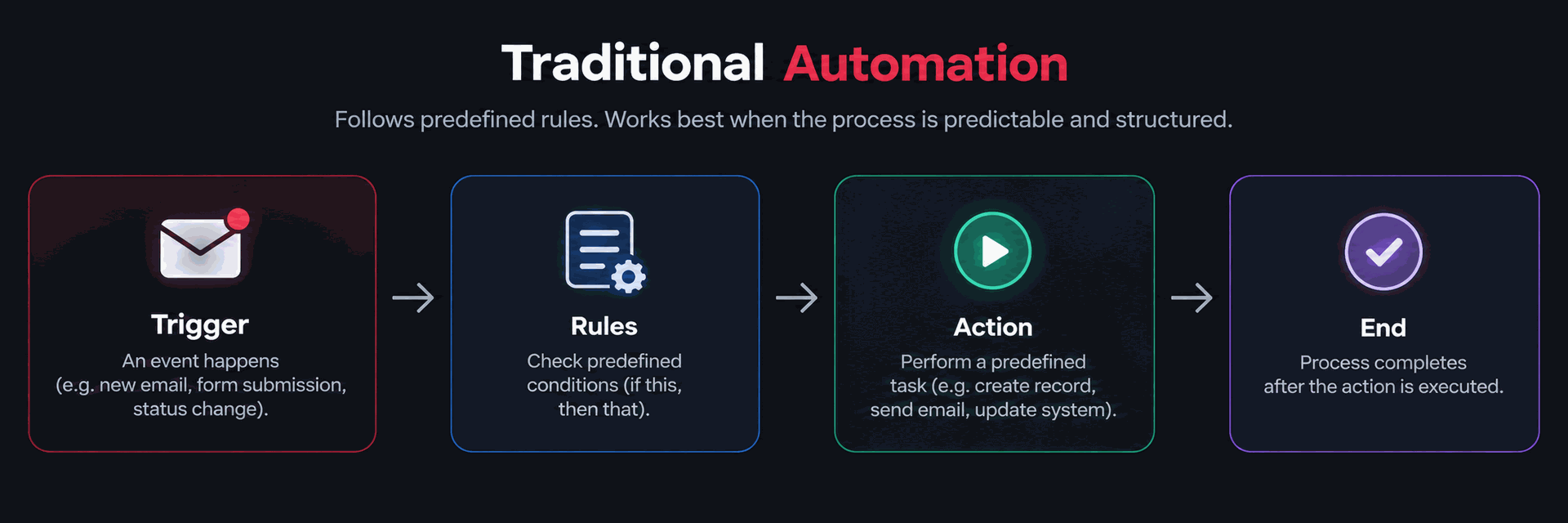
A large amount of business automation can be reduced to a simple concept. If something happens, perform a particular action.
If a form is submitted, create a lead. If an invoice becomes overdue, notify accounts. If a customer selects a certain product category, assign the enquiry to the relevant salesperson.
These workflows are extremely effective when the business process is predictable.
The difficulty appears when the organisation begins trying to automate work that contains interpretation, exceptions and human judgement. The workflow starts accumulating more conditions.
If this happens, check that field. If that field contains a certain value, continue. Unless the customer belongs to another category. If a document is attached, process it differently. If something is missing, send the request somewhere else.
Eventually, the business is not simply automating a process. It is trying to manually describe every possible road the process could take.
Traditional automation generally needs those roads to be designed in advance.
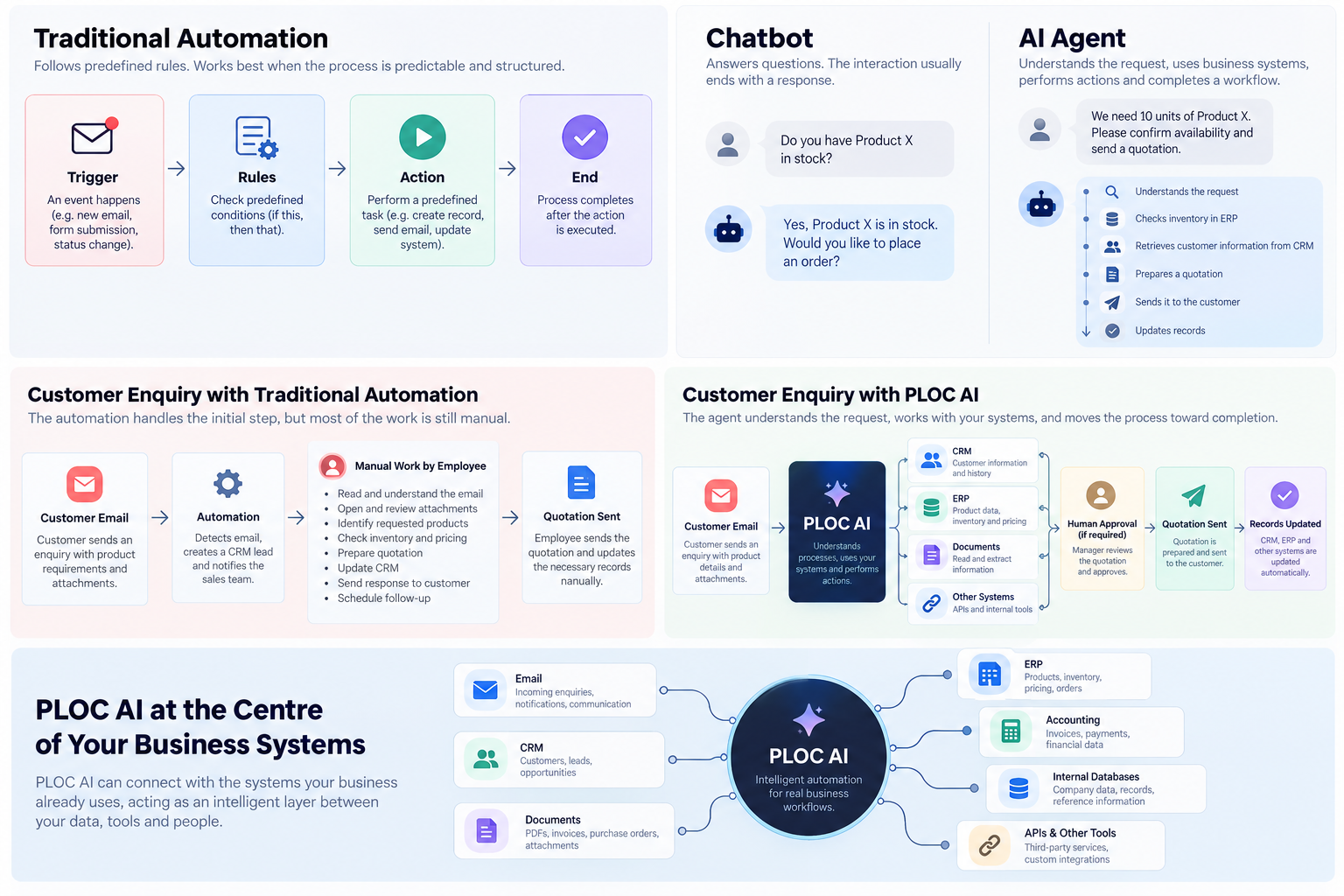
An AI agent changes that relationship. Instead of defining every possible path, the business can define the objective, the available tools, the relevant information, the rules and the boundaries. The agent can then determine which appropriate steps are required to reach that objective.
That does not mean the agent has unlimited freedom. It means the system can interpret the situation before deciding which permitted action makes sense.
So What Is an AI Agent?
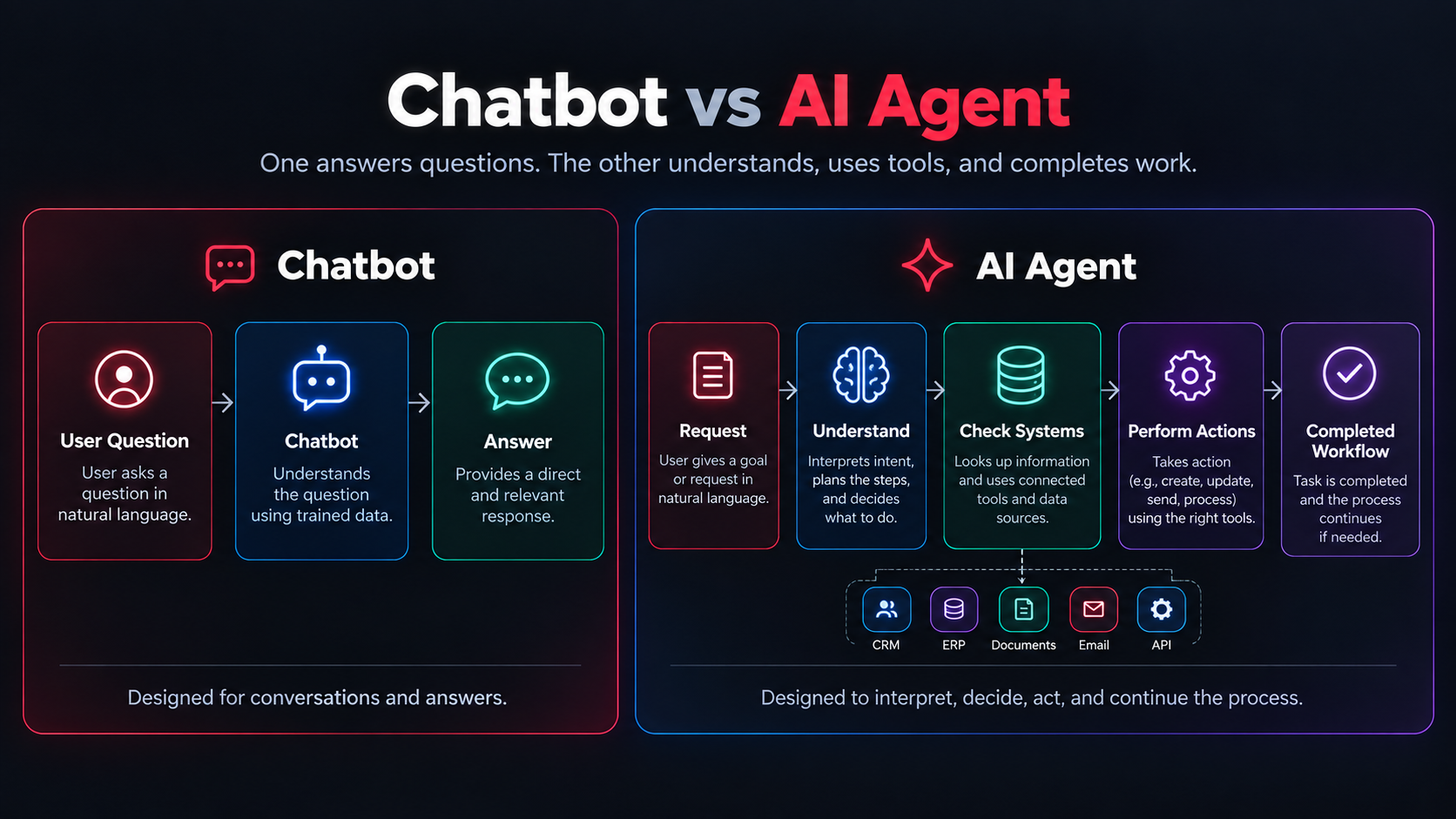
An AI agent is often confused with a chatbot, but the two are not necessarily the same thing.
A chatbot usually receives a question and produces a response. That can be extremely useful for customer support, internal knowledge or general assistance, but the interaction often ends with the answer.
An AI agent can go further.
It can receive information, understand what the information represents, access permitted tools or business systems, retrieve additional context, make decisions within established rules, perform actions and continue through several stages of a process.
Instead of simply answering a customer enquiry, an agent could identify the customer, determine what they are requesting, retrieve their previous activity, check product information, determine whether something is missing, prepare the next step and involve an employee only when necessary.
The difference is not simply that one system is “more intelligent.” The important difference is that the AI becomes part of the business workflow rather than remaining outside it as a conversation tool.
Traditional Automation and AI Agents Solve Different Problems
The easiest way to understand the difference is to look at how each system approaches work.
Traditional automation usually starts with a trigger and follows predefined rules until it reaches a predefined action. The process is generally predictable and works best when the input is structured.
AI agents can start with the same trigger, but they can first interpret what is happening. They can gather relevant information, understand context, choose between permitted actions and continue through a process based on the situation they encounter.
This becomes particularly important when dealing with natural business communication.
Businesses do not operate entirely through clean database fields. They operate through emails, documents, conversations, quotations, purchase orders, support requests, voice calls, spreadsheets and instructions written by people.
Much of that information is unstructured.
Traditional automation asks what rule should be executed next. An AI agent can first ask what is happening, what information is available, what information is missing and what should happen next within the boundaries the organisation has defined.
Imagine a Customer Asking for a Quotation
Consider a normal sales enquiry.
A customer sends an email requesting fifteen units of one product and twenty units of another. They ask whether the products are available, request the company's best price and mention that delivery is required before a specific date. They also attach a previous order for reference.
To a person, this request is relatively straightforward.
The employee reads the email, understands that the customer wants a quotation, opens the attachment, identifies the products, checks the customer history, looks at inventory, confirms pricing, considers the requested delivery date and prepares the quotation.
The important thing is that the employee is constantly interpreting information.
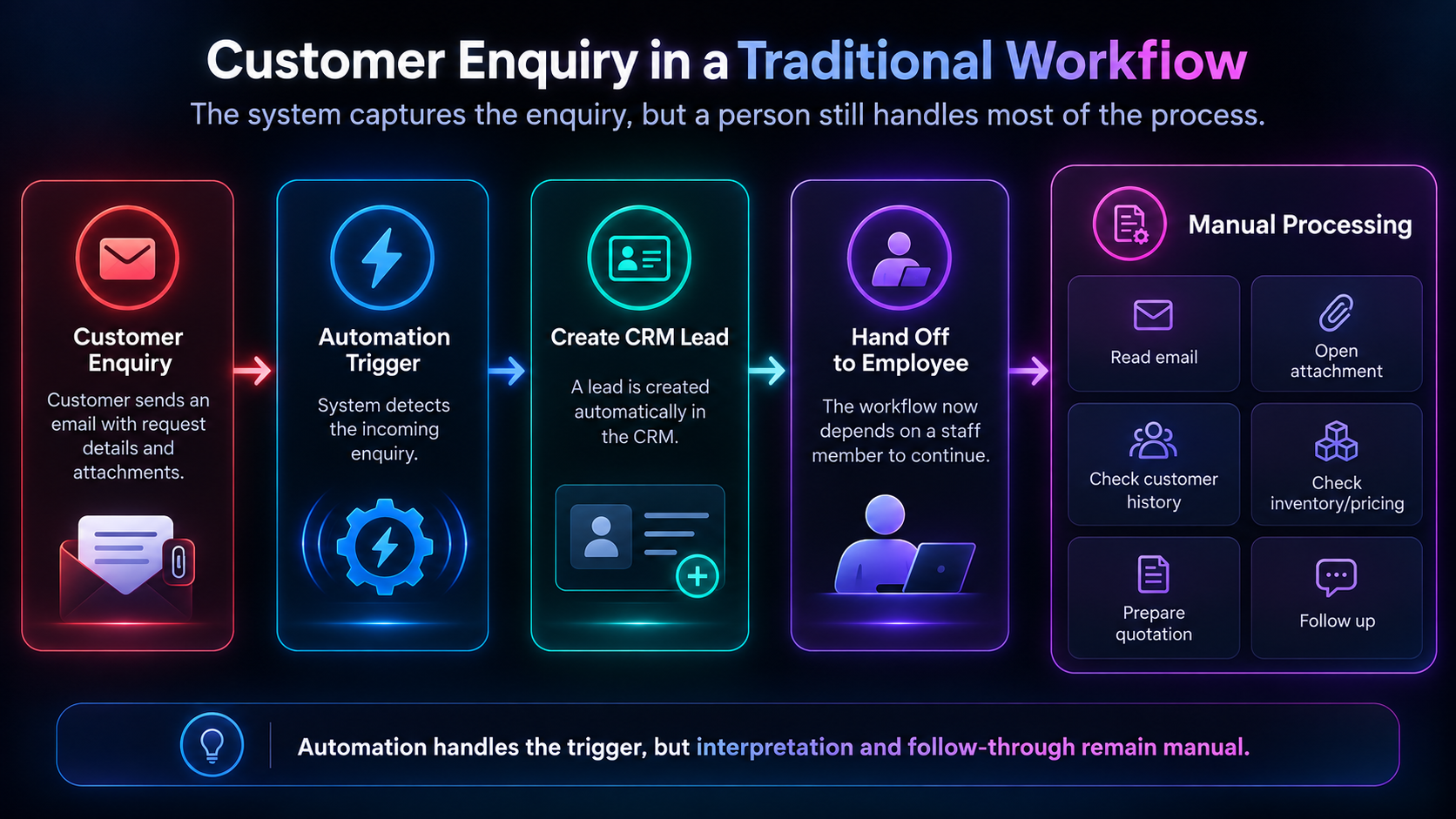
A traditional automation system might detect that an email has arrived. It could create a CRM lead, attach the email and notify the sales department.
That is useful, but most of the actual work still begins after the automation finishes.
The salesperson still has to read the message, understand the request, open the attachment, identify the products, search the relevant systems, gather the information, prepare the quotation, update the CRM and remember to follow up later.
The business has automated a step, but it has not necessarily automated the process.
Now Consider the Same Process With PLOC AI
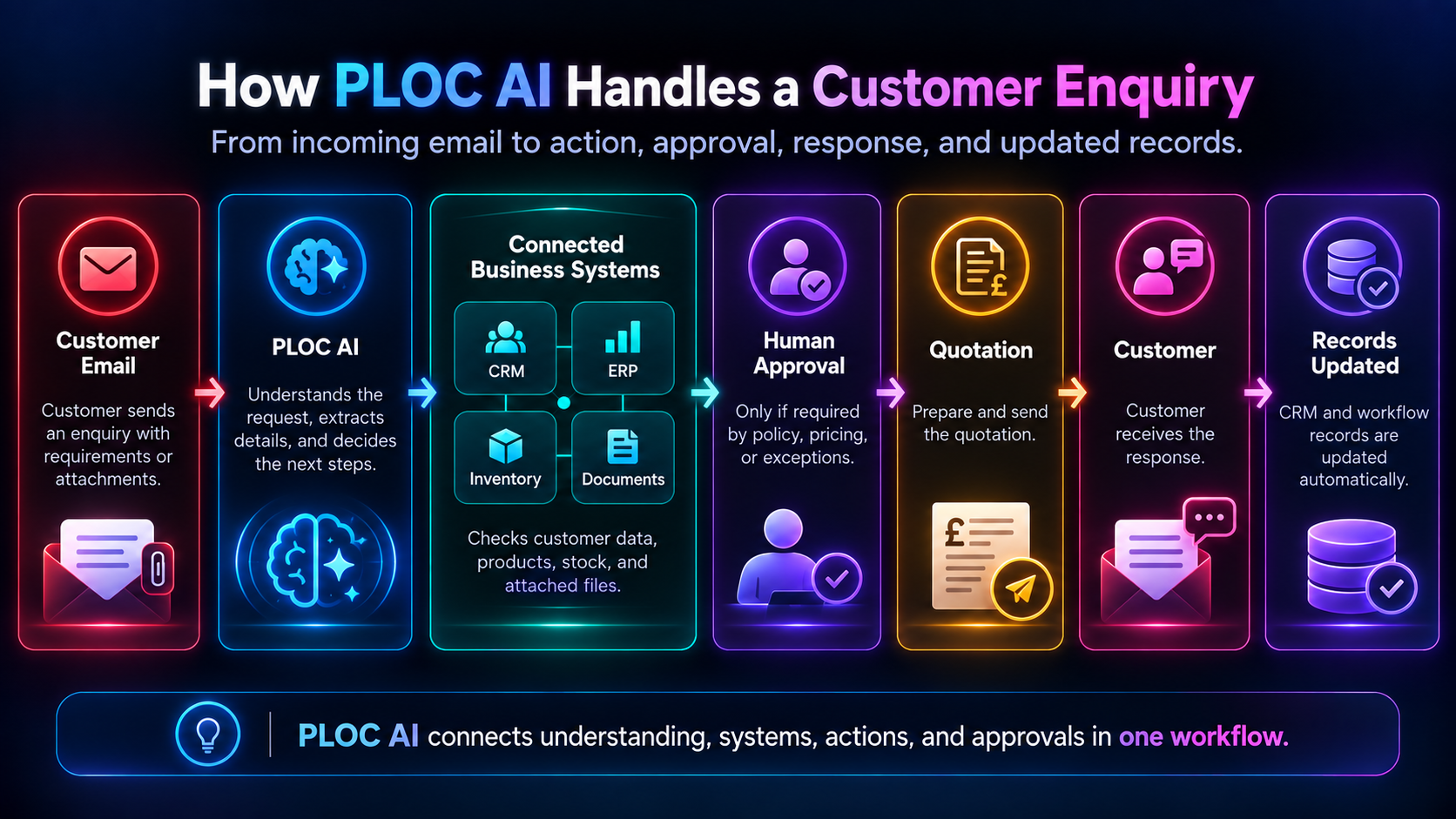
With PLOC AI, the same email can become the beginning of a much broader workflow.
The system can first understand that the message is a quotation request. It can extract important details such as the customer, requested products, quantities, delivery requirements and any special instructions.
If a document is attached, the workflow can include processing that document and using the relevant information as additional context.
PLOC AI can then work with the systems it has been permitted to access. Depending on how the business environment is configured, that could involve checking a CRM, retrieving customer history, accessing product data, checking inventory information or communicating with another internal application through an API.
The agent can determine whether enough information exists to continue.
If something important is missing, it does not necessarily need to send the request into a generic failure queue. It can recognise what information is missing and prepare the appropriate clarification.
If the information is complete, it can continue the workflow.
A quotation may be prepared using the organisation's pricing rules. If the discount exceeds a permitted level or the transaction is above a certain amount, the workflow can pause and request approval from the appropriate employee.
Once approval is given, PLOC AI can continue the process. Relevant records can be updated, the quotation can move to the next stage, internal teams can be notified and future follow-up activity can be created.
The difference is significant.
The business is no longer automating only the arrival of the request. It is beginning to automate responsibility for moving that request through the process.
The Difference Between Automating a Step and Automating an Outcome
This is where AI agents become particularly interesting.
Traditional automation is often designed around individual actions. When an enquiry arrives, create a record. When a status changes, send an email. When a date is reached, create a reminder.
Each automation solves a small part of the process.
An AI agent allows the business to think about the process differently. Instead of asking which individual click or task should be automated, the organisation can begin thinking about the outcome it wants to achieve.
For example, a traditional workflow may be designed to create a CRM lead whenever a sales enquiry arrives.
An agent-based workflow can be designed around a broader objective: process the incoming sales enquiry until it is correctly understood, properly recorded and ready for the sales team, involving an employee only when judgement or approval is actually required.
That changes the scope of automation.
The system is no longer simply moving data from one box to another. It is helping coordinate a business process.
PLOC AI Does Not Need to Replace the Systems a Business Already Uses
Most established companies already have software that performs important functions.
They may have an ERP, CRM, accounting platform, email system, document storage, customer portal, internal database or specialised industry application.
Replacing all of these systems simply to introduce AI would often make little sense.
The opportunity is usually to make those systems work together more intelligently.
In many businesses, employees are currently acting as the integration layer between applications. Someone receives information in one system, reads it, decides what it means, copies data into another system, searches somewhere else for additional information and then decides what to do next.
The software may already be capable of storing everything the business needs. What is missing is often the intelligence connecting the different stages.
This is one of the roles PLOC AI can play.
PLOC AI can become an intelligent orchestration layer between existing applications, company knowledge, AI models, APIs and employees.
Rather than replacing the business environment, it can help connect the environment that is already there.
AI Agents and Traditional Automation Should Work Together
There is another important point that often gets lost in conversations about AI.
Not everything needs artificial intelligence.
If a system needs to add two values together, it should simply calculate them. If an invoice should automatically be emailed after a confirmed system event, a normal deterministic workflow may be the best solution.
Traditional automation is often faster, cheaper and more predictable when the required action is already completely understood.
AI becomes valuable when the workflow involves interpretation.
It becomes useful when an email has to be understood, when a document has to be interpreted, when several pieces of information need to be considered together, or when the next action depends on the context rather than a single database field.
The strongest business workflows will often combine both approaches.
PLOC AI can use intelligent reasoning where understanding is required while relying on normal automation for the predictable actions surrounding it.
The objective should not be to insert AI into every possible step. The objective should be to use the right technology for each part of the process.
Human Approval Still Matters
Introducing AI agents does not mean giving software unrestricted control over the business.
There are decisions where human involvement remains important.
A high-value quotation may need approval. A payment may require authorisation. A contract may need to be reviewed. An unusual purchasing decision may need a manager. Sensitive HR or financial matters may require additional oversight.
An intelligent workflow should recognise those boundaries.
PLOC AI workflows can be designed so the agent performs the repetitive work leading up to the decision, then passes the relevant information to the appropriate person.
The employee does not need to spend twenty minutes gathering information from several systems if the system can prepare everything beforehand. The employee can instead review the result, make the decision and allow the workflow to continue.
This is an important distinction because the objective is not necessarily human-free automation.
The objective is to use human time where human judgement actually adds value.
Where This Becomes Useful Across a Business
The quotation example is only one possible use case.
Sales teams often spend significant time reading enquiries, qualifying opportunities, searching for customer information, preparing responses and updating CRM records. An AI agent can help coordinate much of that work before involving the salesperson at the appropriate stage.
Customer service teams face a similar challenge. A support request may need to be understood, matched with the correct customer, compared against previous cases, checked against a knowledge base and routed to the correct department.
Finance departments work with invoices, purchase documents, approvals and information that often arrives through email or attachments. Operations teams frequently move information between several systems simply to keep processes progressing.
The exact workflow changes from organisation to organisation, but the pattern is often similar.
Employees spend a significant amount of time reading information, understanding what it means, searching for additional information, moving data between applications and deciding what repetitive action should happen next.
Those are the processes where intelligent automation becomes especially interesting.
PLOC AI Is Built Around the Workflow
At JH Systems, our approach with PLOC AI begins with understanding the business process itself.
The first question is not which AI model should be used.
The first question is what actually happens inside the business.
We need to understand what triggers the process, what information enters the workflow, which systems employees use, where information needs to move, where decisions are required, what exceptions normally occur and what the final result should look like.
Once that process is understood, the workflow can be designed around it.
Some stages may use normal automation. Other stages may require AI reasoning. Certain decisions may need human approval. Existing applications may need to be connected through APIs or other integrations.
PLOC AI becomes the layer coordinating those different components around the business objective.
That is very different from simply adding a chatbot to a website and calling the business “AI-powered.”
The Bigger Change Is How We Think About Automation
For many years, businesses have approached automation by asking which individual tasks can be removed from an employee's workload.
AI agents allow us to begin asking a larger question.
Instead of focusing only on how to automate one step, businesses can start examining how much of an entire process can be handled intelligently and responsibly by the system.
That does not mean every business process should become autonomous. It does not mean employees disappear from the workflow, and it certainly does not mean every decision should be handed to AI.
It means the boundary of what can realistically be automated is becoming wider.
Systems can now begin working with the same unstructured information that employees deal with every day. They can understand emails, interpret documents, retrieve context, coordinate applications and move a process forward while escalating situations that require human judgement.
That is the real change.
Building Intelligent Business Processes With PLOC AI
At JH Systems, PLOC AI is our approach to building these kinds of intelligent business workflows.
The aim is not to introduce AI simply because AI is popular. The aim is to identify areas where businesses are losing time to repetitive interpretation, manual coordination and disconnected systems, then determine how much of that process can be handled more efficiently.
Sometimes the answer will be traditional automation.
Sometimes the answer will involve an AI agent.
Most of the time, the strongest solution will combine intelligent automation, deterministic workflows and human decision-making into one connected process.
The technology comes after the workflow is understood.
That is how we believe practical AI should be introduced into a business: not as another isolated tool employees need to manage, but as intelligence built around the work they are already doing.
PLOC AI by JH Systems is built around that idea: connecting intelligence, business systems and human decision-making into workflows designed around real business processes.